Interview: Stephen Rosser discusses the contradiction at the heart of the UK renewables sector and how it could turn into opportunity
Who says the sun never shines in the UK? Our solar energy sector has been breaking records for generation in recent years. Solar assets held in funds such as NextEnergy Solar (NESF) continue to outperform their annual generation targets and perform well operationally.
Despite this, renewable energy investment companies (IC) have seen their share prices trade at a meaningful discount over the past two years, given a perception that these companies are not performing well.
What is a discount to NAV and why does it matter?
Investment Companies have two key measures of value:
- Net asset value (NAV) – what all the assets in the fund would be worth if they were sold today at market value.
- Share price – the price at which the company’s shares trade on the stock market, which is driven by investor demand and supply.
If the share price is higher than the NAV (divided by the number of shares – NAV per ordinary share), it is called a premium. If the price is below the NAV per ordinary share, it is a discount.
When funds trade at a premium, it signals strong demand and positive investor sentiment. This allows funds to raise capital by issuing new shares and acquire new assets to grow portfolios or repay debt, whilst adding to shareholder value by increasing the NAV. Conversely, discounts stifle growth as demand falls and Company’s become capital constrained as they are restricted from raising capital by issuing more shares.
Why are solar shares trading at a discount to NAV?
Discounts in many solar energy ICs are amongst the widest – currently ranging between 30% and 40%. This has been driven by macro pressures outside of investment managers’ control, including:
- High interest rates.
- Significant capital outflows from institutional investors as they pivot to global markets.
- Government policy uncertainty, including recent changes to the way subsidised renewable projects are indexed to inflation – a retrospective act that reduces income from existing contracts and harmed investor confidence during the consultation phase.
- Long-term solar electricity prices falling, despite energy demand rising.
- Higher UK gilt yields prompting investors to switch away from ICs towards these lower risk assets.
- FCA cost‑disclosure rules which ‘double count’ fees and make ICs appear artificially expensive, despite those costs already being reflected in the share price.
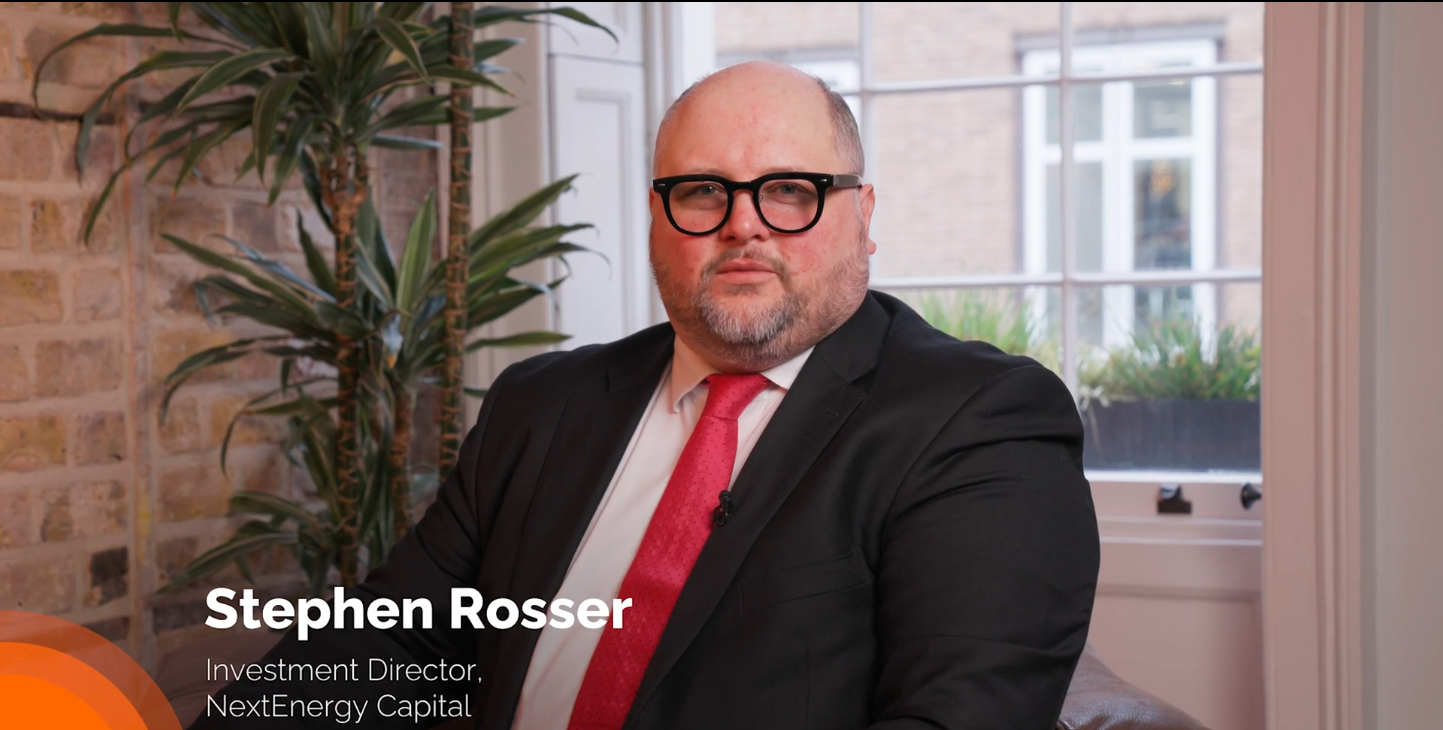
The result of these factors for NESF and its peers has been a persistent discount. Stephen Rosser, investment director at NextEnergy Capital, NESF’s manager, sums up the impact: “You can’t raise capital when you’re trading at a discount. So over that time, the capital markets have been off limits and we’ve not been able to raise money to pay down debts or grow, which further affects investor confidence.”
From discount to opportunity
However, the factors NESF can control remain robust, as Rosser explains: “Our diversified portfolio continues to deliver solid operational performance across both our solar and battery storage assets.”
NESF owns over 100 operational assets, which are well diversified by geography and technology. Over six months to September 2025, the fund’s total operational cash income after expenses was £48 million versus £39 million a year earlier, and our dividend cover rose to a robust 1.7x at the latest interim results.
“The managers are highly selective in what they buy and build, leading to high quality performance,” adds Rosser.
With the discount to NAV caused by market dislocation – where our share price does not reflect our true asset value – rather than any weakness in the fund, it presents a unique opportunity for investors.
“Market tailwinds could see that discount narrow,” says Rosser. “As we start to see interest rates stabilise and more certainty over policy, investor appetite for precisely this type of high-quality infrastructure asset class is coming back.”
A key tailwind is the UK government’s commitment to growing renewables as it tries to solve a trio of challenges in the energy sector – security, affordability and sustainability.
Solar contributed 6% of the UK’s electricity in 2025, up by nearly one-third year-on-year.
“The UK sets more records for solar generation every year, and the government wants to maintain that momentum by tripling output by 2030,” says Rosser. “We estimate that will require £4 billion to £5 billion annual investment.”
“Solar’s simple business model can support this. The assets are relatively easy to operate. They’re the quickest, cheapest renewable investment to construct, partly because they have no moving parts – you can build a solar farm in seven to eight months with the correct planning permissions and grid approvals. Even the irradiation throughout the year is constant and modellable in comparison to wind generation.”
This positive outlook creates huge potential value for NESF’s shareholders.
Closing the discount
While macroeconomic tailwinds are starting to pick up, we are still working hard on the factors we can control to close the discount, such as:
- Hedging prices to lock in revenue certainty.
- Using our size and specialist knowledge to drive asset efficiency and performance. For example, NESF’s spare parts programme can dramatically reduce asset downtime caused by failed components.
- Selling assets through our capital recycling programme to create liquidity and allow the fund to repay debt.
“NextEnergy Capital is exploring every possibility for stabilising the fund’s NAV and reducing its discount and we’re putting our heart and soul into that. It’s also the NextEnergy Solar Funds independent Board’s top priority.”
“The Board alongside us, the Investment Adviser and Manager are concluding their strategic review to tackle this issue, the review is looking at how we can best deliver value for shareholders”
Rosser adds that NESF’s appointment of Tony Quinlan, the fund’s chair, in December 2025, adds a highly experienced steward to our credentials.
Taking all these factors together, there’s plenty for investors to be optimistic about, he says.
Disclaimer:
This document is issued by NextEnergy Capital Limited (“NEC”), which is authorised and regulated by the UK Financial Conduct Authority (“FCA”) with registered number 471192.
This document is not an offer to sell, or a solicitation of an offer to acquire, securities of the NextEnergy Solar Fund Limited (the “Fund”) in the United Kingdom or in any other jurisdiction. Neither this document nor any part of it shall form the basis of or be relied on in connection with or act as an inducement to enter into any contract or commitment whatsoever.
The information contained in this document has been prepared in good faith but it is subject to updating, amendment, verification and completion. This document and any terms used herein are a broad outline of the Fund only.
The Fund is incorporated in Guernsey, Channel Islands and is a registered closed-ended investment scheme under the Protection of Investors (Bailiwick of Guernsey) Law, 1987, and the Registered Collective Investment Scheme Rules 2008. The Fund is not an Authorised Person under the UK Financial Services and Markets Act 2000 (“FSMA”) and, accordingly, will not be registered with the FCA. The Fund will therefore only be suitable for professional or experienced investors, or those who have taken financial advice.